
Share
Industrial Upgrading Explained: From Legacy Production to Smart Operations

Industrial Upgrading Explained: From Legacy Production to Smart Operations
Industrial upgrading is no longer a distant manufacturing concept reserved for large automotive plants or semiconductor fabs. In home electronics, it is becoming a practical response to a difficult operating environment: product refresh cycles are shorter, component availability can change quickly, labor costs are under pressure, and consumers increasingly expect connected devices to work reliably from the first setup through years of software updates.
For manufacturers of televisions, air conditioners, kitchen appliances, robot vacuums, smart speakers, home security devices, and other connected products, the shift is not simply about buying more robots. Industrial upgrading means redesigning how information, materials, equipment, people, and decisions move through the business. A factory may still assemble physical products on a line, but its operations increasingly depend on real-time data, digital work instructions, traceable components, automated inspection, and feedback from the market after shipment.
This transition matters because many legacy production models were built for a different type of demand. They performed well when product variants were limited, production runs were long, and changes could be planned months in advance. Smart home electronics operate under less predictable conditions. A new chipset, wireless protocol, app feature, packaging requirement, or regional compliance rule can affect the production plan with little room for error.
What Industrial Upgrading Actually Changes
The term is sometimes reduced to automation, but that is too narrow. Automation can be part of industrial upgrading, yet a factory with automated stations and disconnected data is still likely to struggle with quality investigation, inventory visibility, and engineering changes. The deeper shift is from isolated activities to connected operations.
In a conventional environment, production planning may rely on spreadsheets, paper-based instructions, manual recording of defects, and separate systems for procurement, warehousing, testing, and after-sales service. Each process can function on its own, but information travels slowly between them. When a field failure appears after launch, linking it back to a batch of boards, a firmware revision, a component supplier, and a final assembly line may require substantial manual work.
A more mature digital operation aims to shorten that path. Manufacturing execution systems, connected test equipment, barcode or serial-number traceability, warehouse software, equipment monitoring, and product lifecycle management tools can create a more continuous record. The value is not the presence of a dashboard. It is the ability to answer operational questions with evidence: Which units used a particular component lot? Did a yield change after a process adjustment? Are failures concentrated in one station, one shift, or one software version? Can the plant safely switch to an approved substitute material?
For consumer electronics businesses, this is especially relevant because the product itself is often digital. A smart appliance can generate diagnostic signals after it reaches the home, while the factory holds process and test records from its assembly. Connecting those two worlds, carefully and with appropriate privacy controls, creates a more useful feedback loop than treating manufacturing and service as separate functions.
Why Home Electronics Is a Demanding Upgrade Environment
Home electronics combines challenges that do not always appear together in other sectors. Products are often high-volume but highly seasonal. A single platform may be sold in multiple markets with different power plugs, language settings, wireless configurations, labeling rules, and energy-related requirements. The same outer design may contain different internal components because of supply conditions or regional specifications.
The manufacturing process can also be deceptively complex. Final assembly may look straightforward, but product performance depends on earlier decisions involving printed circuit boards, sensors, motors, compressors, displays, antennas, batteries, plastics, thermal design, firmware, and packaging. In connected devices, a unit can pass a basic functional test yet still present problems during Wi-Fi onboarding, cloud registration, app pairing, or over-the-air update handling.
That is why industrial upgrading usually reaches beyond the final line. It may involve supplier quality records, incoming inspection, surface-mount technology data, firmware version control, end-of-line testing, repair analysis, and logistics planning. The most useful programs identify where information is being lost rather than assuming every process needs the same technology.
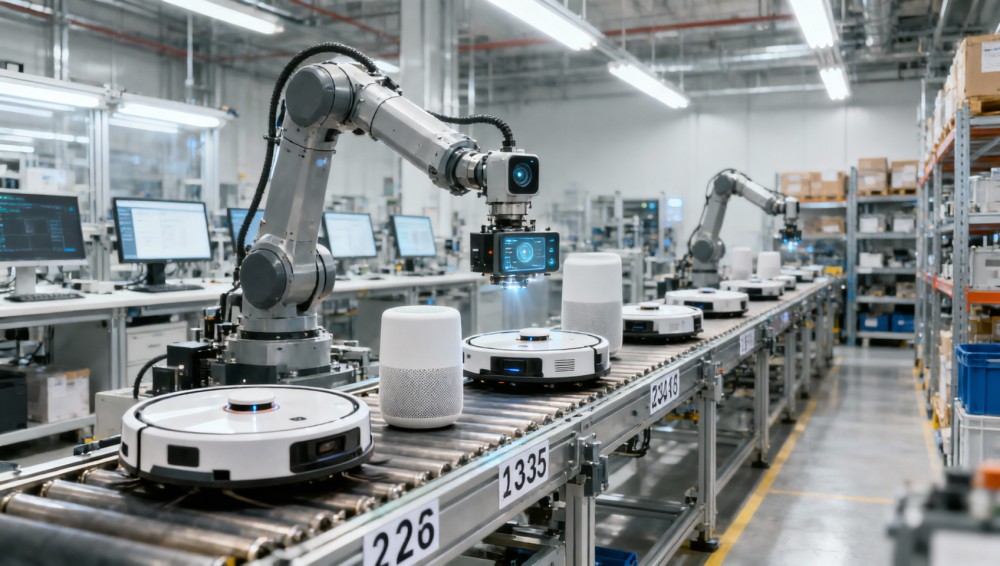
A smart operation is therefore not necessarily a fully “lights-out” factory. In many home appliance and consumer electronics settings, people remain essential for changeovers, complex assembly, cosmetic checks, engineering validation, repair, and exception handling. The difference is that their work is better supported by timely instructions and usable production data, rather than dependent on informal knowledge alone.
The Building Blocks of a Smarter Factory
Industrial upgrading tends to develop in layers. The starting point is often visibility: knowing what is being made, what materials are available, which equipment is running, and where quality issues are occurring. Once those basics are dependable, companies can use the data for more advanced planning, process optimization, and selective automation.
Digital work instructions are a practical example. Instead of relying only on printed documents, operators can receive the correct assembly sequence, torque requirement, test method, or configuration step for a specific model. This becomes more valuable when a line builds several variants. It reduces the risk that an instruction written for one version is applied to another, although it does not replace training or process discipline.
Traceability is another common priority. At a basic level, it links a finished serial number to key components and production events. The appropriate depth depends on the product and risk profile. A simple appliance may not need the same granularity as a connected security device or battery-powered product. The important question is whether the traceability design supports realistic quality containment, warranty analysis, and service investigation without creating a data burden nobody uses.
Automated optical inspection, machine vision, robotics, collaborative robots, automated guided vehicles, and automated testing can also play meaningful roles. Their fit depends on repeatability, takt time, product variation, safety, and maintenance capability. A robot may be effective for repetitive handling of stable components, but less attractive where product formats change frequently and fixtures must be redesigned each time. Investments should be judged against the whole process, including downtime, programming, spare parts, validation, and operator support.
Data analytics is often presented as the final destination, but it only works when data definitions are consistent. If one system records a defect by product family, another by station, and a third by repair code, the resulting analysis can be misleading. Before applying predictive models or artificial intelligence, manufacturers usually need to settle more basic questions about data ownership, timestamps, naming conventions, and process governance.
A Useful Comparison: Legacy Production and Smart Operations
The right-hand column should not be read as a checklist of software purchases. A plant may gain more from fixing material identification and test-data collection than from deploying a large platform too early. In practice, upgrading works best when it begins with an operational bottleneck that teams already recognize: recurring rework, delayed fault isolation, unstable changeovers, missing inventory accuracy, or poor visibility across contract manufacturing partners.
Risks That Are Easy to Miss
One recurring mistake is treating the project as an information technology installation rather than an operating-model change. A new system can expose weak processes, but it cannot resolve unclear responsibilities by itself. If engineering, quality, procurement, production, and service teams use different definitions of an approved change, digitalizing the workflow may simply make the disagreement more visible.
Cybersecurity also deserves attention. Connected production assets, remote support tools, cloud systems, and smart products increase the number of interfaces that require management. Consumer electronics manufacturers need to consider both factory security and product security, particularly where devices collect household data or connect to home networks. Specific obligations depend on the markets served and the product category, so legal and technical requirements should be verified against current local rules and applicable standards.
There is also a human risk. Operators and supervisors may see digital tools as surveillance or as a threat to established roles if implementation is poorly communicated. The better approach is to involve the people closest to the line in defining usable screens, exception paths, and training needs. Their experience often reveals why an apparently simple process is handled differently in real production.
Finally, an upgrade can create vendor dependence if interfaces, data access, and long-term support are not considered early. Businesses should understand who owns production data, how it can be exported, what happens when equipment is replaced, and whether a chosen system can connect with existing enterprise resource planning, quality, and product lifecycle tools. These questions are less glamorous than a demonstration of automation, but they shape the usefulness of the investment over time.
What to Watch When Researching the Transition
For anyone tracking the consumer electronics sector, industrial upgrading can be assessed through observable operational signals rather than broad claims about “smart manufacturing.” Look for changes in how companies discuss factory flexibility, component traceability, in-house versus outsourced assembly, automated testing, software configuration management, repair data, and supply-chain coordination. Announcements about a new factory matter, but so do quieter developments such as a revised service platform, an expanded quality system, or a new partnership around manufacturing software.
It is also worth separating capacity expansion from capability expansion. A company can add production floor space without fundamentally changing how it manages quality or product variation. Conversely, a targeted upgrade to test data, serial-number control, or engineering change management may have a larger effect on operational reliability than a highly visible expansion project.
This is where ongoing industry coverage has practical value. News across internet services, business services, consulting, office supplies, and consumer electronics can reveal connected trends that do not fit neatly within one factory report. Market updates, company developments, product insights, and feature analysis help place manufacturing decisions beside shifts in retail channels, connected-device ecosystems, software expectations, and service models.
Industrial upgrading in home electronics is ultimately a move toward better decisions under changing conditions. The technology matters, but the more revealing questions are operational: Can the manufacturer manage variant complexity without losing control? Can it trace a problem to its source? Can engineering changes reach the line accurately? Can field feedback improve the next build? The answers provide a clearer picture of smart operations than any factory label alone.
Industry News Desk
Related News
- 00
0000-00
How energy costs are shaping industrial upgrades in Europe - 00
0000-00
How hybrid work is changing the office furniture market - 00
0000-00
What ink and toner market trends mean for cartridge prices - 00
0000-00
How production capacity changes could affect wood panel prices - 00
0000-00
What company expansion news reveals about market demand in Europe
0000-00
Weekly Insights
Stay ahead with our curated technology reports delivered every Monday.