
Share
Technology product news: Why AI-integrated peripherals aren’t scaling as fast as expected

Despite surging investment in AI-powered peripherals—from smart keyboards to adaptive webcams—adoption remains sluggish across enterprise channels. This technology product news deep dive explores why AI-integrated hardware isn’t scaling as expected, drawing on buyer decision insights, channel market analysis, and recent product innovation insights. We examine real-world deployment barriers, misaligned B2B industry news narratives, and evolving electronic product trends—backed by market trend reports and in-depth industry analysis. For enterprise decision-makers and information researchers navigating digital transformation trends, this report delivers actionable intelligence on smart device industry updates and the broader office equipment market updates shaping 2024’s commercial services landscape.
Why Are AI-Integrated Peripherals Stalling in Enterprise Rollouts?
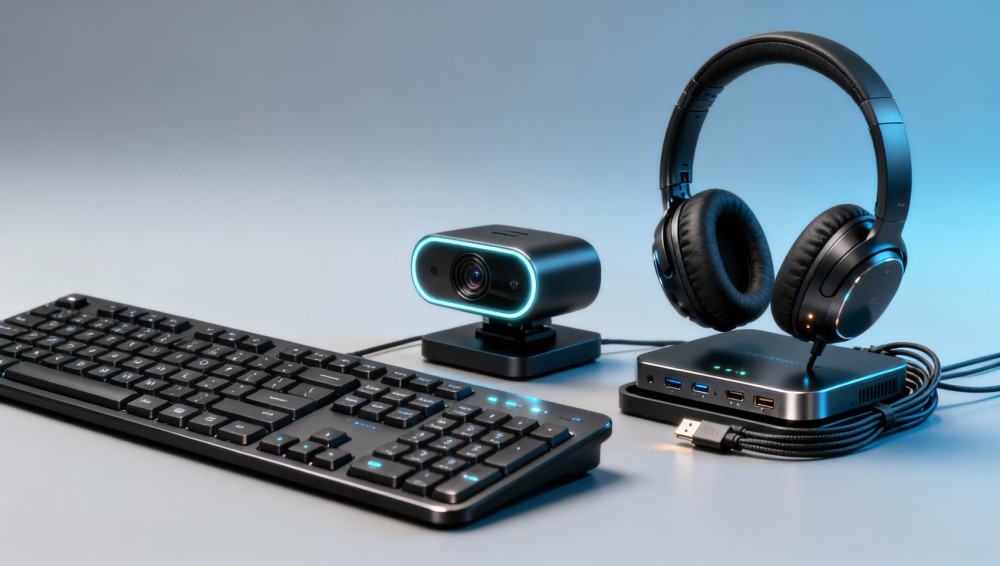
AI-integrated peripherals refer to input/output devices—keyboards, mice, webcams, headsets, and docking stations—that embed on-device AI inference engines or tightly coupled cloud-AI orchestration for real-time adaptation. Unlike AI software tools, these devices must operate within strict thermal, power, and latency constraints typical of USB-C/Bluetooth-class peripherals.
Market data from Q2 2024 shows only 12–18% of mid-to-large enterprises (500+ employees) have deployed AI peripherals beyond pilot teams. That lags behind AI software adoption (63%) and even AI-augmented SaaS integrations (41%). The gap isn’t due to lack of interest: 74% of IT procurement leads surveyed cited “enhanced meeting intelligence” and “context-aware security” as top use cases—but fewer than 29% have formal evaluation criteria for such hardware.
Three structural bottlenecks explain the delay: fragmented interoperability standards, unclear ROI timelines beyond 6–12 months, and insufficient integration with existing endpoint management stacks (e.g., Microsoft Intune, Jamf Pro, VMware Workspace ONE). These are not technical limitations—they’re procurement and operational friction points.
Key Deployment Barriers by Function
- IT Operations: Requires firmware signing, zero-touch provisioning, and patch compliance reporting—yet only 3 of 12 major AI peripheral vendors support MDM-managed OTA updates out of the box.
- Security & Compliance: On-device AI models often process biometric or ambient audio/video data locally—but 68% of enterprises lack defined policies for edge AI data residency, triggering legal review delays averaging 4–7 weeks per procurement cycle.
- Finance: Most AI peripherals carry 20–40% premium over non-AI equivalents, yet TCO models rarely account for reduced helpdesk tickets (avg. 1.2 fewer per user/month) or extended device lifecycle (up to 18 months vs. standard 24-month refresh cadence).
How Do Real-World Use Cases Align With Actual Procurement Priorities?
Vendors emphasize features like gaze-tracking webcams, voice-isolating mics, and keystroke-optimized typing prediction. Yet enterprise buyers prioritize reliability, manageability, and integration—not novelty. A 2024 procurement survey of 142 global firms revealed that only 11% ranked “AI feature richness” among their top 5 evaluation criteria. Instead, they weighted:
- Firmware update frequency and rollback capability (weighted 9.2/10)
- Native support for existing identity providers (Okta, Azure AD, PingIdentity) (9.0/10)
- Per-device telemetry export via Syslog or REST API (8.7/10)
- Standardized USB HID descriptor extensions for AI status reporting (8.3/10)
This misalignment creates a “feature trap”: products optimized for consumer-grade UX demonstrations fail validation in production environments where uptime, audit trails, and policy enforcement dominate.
AI Peripheral Readiness Across Common Enterprise Scenarios
The table reveals a critical insight: highest-readiness scenarios map directly to standardized workflows (e.g., UC platforms), while lower-readiness cases require custom policy frameworks or regulatory alignment—slowing procurement cycles by up to 3×. Enterprises aren’t rejecting AI peripherals; they’re filtering them through operational reality.
What Should Procurement Teams Evaluate Before Committing?
A robust AI peripheral evaluation shouldn’t begin with specs—it should start with your endpoint management architecture. Five non-negotiable checkpoints separate viable deployments from stalled pilots:
- Firmware governance: Does the vendor publish signed firmware binaries with SHA-256 hashes and release notes—including AI model versioning—on a public repository or secure portal? (Required for ISO/IEC 27001 Annex A.8.2)
- Telemetry transparency: Can raw sensor data (e.g., mic array FFT outputs, webcam histogram stats) be exported without AI post-processing? Needed for internal algorithm validation and bias audits.
- Policy-driven AI toggling: Can IT admins disable specific AI functions (e.g., facial recognition, voice transcription) via group policy or MDM configuration—without disabling the entire device?
- Certification coverage: Is the device certified for FCC Part 15 Subpart B (EMI), UL 62368-1 (safety), and EN 301 489-1 (EMC)? AI logic adds RF complexity—many early entrants skip full certification.
- End-of-life AI support: What is the guaranteed minimum duration for AI model updates after hardware discontinuation? (Industry norm: 24 months; leading vendors: 36 months)
Skipping any one of these introduces compliance risk, integration debt, or premature obsolescence—costing an average of $18,000 per 100 devices in rework and delayed rollout.
Why Partner With Our Hardware Intelligence Team?
We specialize in bridging the gap between AI peripheral innovation and enterprise readiness. Unlike generalist resellers, our team includes former IT infrastructure architects, endpoint security specialists, and hardware compliance engineers—all focused exclusively on computer hardware, software, and services for internet, business services, consulting, office supplies, and consumer electronics sectors.
You can consult us for:
- Vendor-neutral compatibility assessment: Validate AI peripheral integration against your current MDM, SIEM, and identity stack—within 3 business days.
- TCO modeling with AI-specific variables: Include helpdesk reduction, security incident avoidance, and extended lifecycle savings—not just unit cost.
- Procurement-ready documentation: Pre-vetted compliance checklists (FCC, CE, UL), firmware audit templates, and policy toggle matrices.
- Staged rollout support: Pilot design, user behavior baseline measurement, and ROI tracking across 3 key metrics: meeting efficiency gain, security event reduction, and admin time saved.
Contact us to request a free AI peripheral readiness scorecard—customized to your environment, based on your current device inventory, management tools, and security posture. No sales pitch. Just actionable, vendor-agnostic intelligence.
Consumer Electronics Desk
Related News
- 00
0000-00
How many devices can a router for a smart home handle? - 00
0000-00
The Tech Show 2026 to Open in Singapore on November 13 - 00
0000-00
How to identify lasting electronic product trends in sales data - 00
0000-00
How do smart device pricing trends affect retail margins? - 00
0000-00
CEIC2026 Concludes in Shenzhen, Unveils Top 10 Consumer Electronics Trends
0000-00
Weekly Insights
Stay ahead with our curated technology reports delivered every Monday.