
Share
How Do Global Trade Shifts Affect Electronics Component Prices?

Global trade shifts affect electronics component prices by changing the landed cost, availability, lead time, and commercial risk attached to every part entering a consumer electronics product. A tariff announcement can alter the cost of a control board before its design changes. A disruption at a port can make an otherwise stable display module harder to obtain. Currency movement can change the local cost of a battery cell even when the supplier's quoted amount remains unchanged.
For household electronics, these effects rarely stay confined to a single component. A smart appliance, television, cordless vacuum, air purifier, kitchen device, or home entertainment product depends on an interconnected bill of materials. Semiconductors, printed circuit boards, passive components, display panels, motors, plastic resins, magnets, battery materials, connectors, packaging, and freight capacity can each be exposed to different trade conditions. A price change in one area may prompt substitutions, revised production schedules, or changes to the final product configuration.
Trade Policy Changes the Real Cost of a Component
Component pricing is often discussed as a supplier quote, but the quote is only one layer of cost. The amount paid after a part crosses borders can include customs duties, tariff classifications, brokerage fees, inland transport, insurance, warehousing, handling, and the cost of financing inventory while it is in transit. When trade policy shifts, the impact depends on where the component was made, where it was substantially processed, where it is shipped from, and how it is classified at import.
A finished display assembly and its individual materials may fall into different classifications. The same is true for a populated printed circuit board, an unpopulated board, a cable harness, or a power adapter. Classification errors can create unexpected charges, delayed clearance, or later adjustments. A price comparison that ignores the import treatment of a specific part can therefore make a lower factory quote appear more attractive than it actually is.
Origin is equally important. A component assembled in one location may contain wafers, glass substrates, cells, magnets, or integrated circuits from several others. Trade rules may focus on the location of final assembly, the origin of key materials, or whether a defined transformation occurred. Documentation needs to match the commercial flow. Purchase orders, invoices, packing lists, certificates of origin, manufacturing records, and customs declarations should not describe the part inconsistently.
Trade news can also influence prices before a rule becomes active. Suppliers may reserve capacity, revise validity periods, request deposits, or shorten quotation windows when they expect a duty change. Distributors can raise prices when replacement inventory will arrive at a higher landed cost, even if their current stock entered under prior conditions. Conversely, a tariff suspension or a reduction in trade friction may not produce an immediate price decrease if inventories were purchased at a higher cost or if freight and currency conditions remain unfavorable.
Shipping Disruptions Reach Deep into the Bill of Materials
Ocean freight problems are not only logistics problems. They become component pricing problems when transit time becomes uncertain. Delays can force the use of air freight for small, high-value electronic parts, such as microcontrollers, memory devices, wireless modules, or power-management ICs. Air freight may be commercially tolerable for a few reels of chips, yet impractical for bulky items such as large panels, molded housings, batteries, or assembled appliance modules.
A routing disruption can create expenses beyond the freight invoice. Containers may require extra dwell time, cargo may miss a factory receiving window, and production may need to stop while material is located or rerouted. If a missing part prevents final assembly, the cost of idle labor, rework, rescheduling, and incomplete inventory can exceed the purchase price of that part. Components with long qualification cycles are especially exposed because switching sources in the middle of a shipment problem may not be technically feasible.
Lead-time variability matters as much as average lead time. A component that normally arrives within a predictable range can be planned with modest safety stock. Once arrival dates become unreliable, more inventory may be held to protect assembly schedules. That inventory ties up cash, needs storage conditions, and may age. Moisture-sensitive semiconductor packages require controlled handling after opening. Lithium-ion cells require appropriate storage and transport controls. Display panels need protection against shock, bending, and humidity. The carrying cost is therefore different for each category.
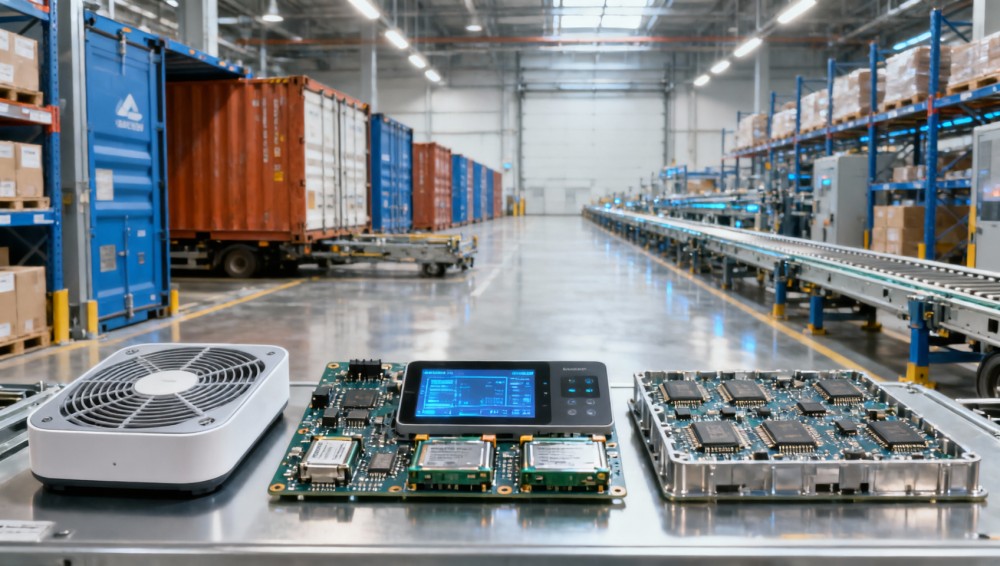
Freight disruptions also affect packaging decisions. A carton designed for a short, routine route may be insufficient for repeated handling, longer sea exposure, or a route with more transshipment points. Increasing corner protection, desiccant, moisture barriers, pallet stabilization, or shock indicators can raise the delivered cost but reduce damage risk. The correct decision depends on the failure mode: panel breakage, corrosion at terminals, deformation of molded plastic, water exposure, or loss of tray orientation can each create different downstream losses.
Semiconductors React to Capacity, Allocation, and Geography
Semiconductor prices are shaped by fabrication capacity, packaging and test availability, substrate supply, demand from multiple end markets, and the geographic concentration of specialized processes. A home electronics device may contain only a few high-value chips, but a delay in one controller or wireless module can halt the entire product. Low-cost passives are often easier to replace than a microcontroller whose firmware, pin layout, memory size, and peripheral functions are tightly linked to the product design.
When trade restrictions, export controls, or regional tensions affect semiconductor flows, the immediate result may be a longer lead time rather than a published price increase. That distinction matters. A formal unit price may remain stable while brokers quote sharply different spot prices for available inventory. Spot purchases carry their own risks: traceability may be incomplete, date codes may not align with requirements, packaging may be damaged, and storage history may be unknown. Counterfeit prevention and incoming inspection become more important when normal authorized channels cannot meet demand.
Substituting a chip should be treated as an engineering change, not a purchasing shortcut. Even a nominally compatible alternative can differ in startup behavior, electromagnetic emissions, temperature performance, firmware support, security features, analog accuracy, or supply voltage tolerance. A revised controller may require firmware updates, new test limits, board changes, or regulatory retesting of the finished appliance. The apparent savings from a lower-priced alternate part can disappear if validation takes longer than the supply interruption.
For this reason, component records benefit from more detail than a manufacturer part number. The approved source list, package type, temperature grade, software version, qualification status, country-of-origin evidence, and acceptable revision range should be visible at the point where sourcing and engineering decisions meet. Without that connection, a trade-driven substitution can introduce a hidden reliability or compliance issue.
Displays, Batteries, and Materials Follow Different Cost Patterns
Display pricing responds to a separate mix of trade conditions. Glass substrates, polarizers, backlight assemblies, driver ICs, touch layers, optical films, and bonded cover glass may move through different supply chains before reaching final module assembly. A disruption affecting one layer can constrain the whole module. Size, resolution, brightness, refresh behavior, viewing angle, interface type, and mechanical mounting dimensions all limit the ease of substitution.
In household electronics, a display is often a visible quality signal, so specification changes carry commercial consequences. Replacing a panel with one that has a slightly different color temperature, luminance range, bezel geometry, connector location, or optical bonding structure can alter the finished product experience. It may also require adjustments to housing tolerances, user-interface graphics, backlight tuning, or factory calibration. Treating display modules as interchangeable because they share a diagonal measurement is a common mistake.
Battery pricing is exposed to cells, active materials, separators, electrolytes, protective circuitry, metal inputs, shipping rules, and hazardous-goods handling capacity. A battery pack quote can rise because of cell cost, but it can also rise because a route has fewer carriers willing to handle the shipment or because packaging and documentation requirements add complexity. Changes in cell origin or pack assembly location may affect tariff exposure separately.
Cell substitution requires careful review of nominal voltage, charge profile, discharge curve, internal resistance, cycle behavior, dimensional tolerance, connector wiring, thermal response, and battery-management-system settings. Higher capacity alone is not proof of compatibility. In a cordless appliance or portable home device, mismatched behavior can affect runtime indication, charging duration, thermal protection, motor performance, or the useful life of the pack.
Materials create another indirect pathway. Copper affects cables, motors, inductors, heat spreaders, and circuit boards. Aluminum may affect heat sinks and housings. Rare-earth materials can influence motors and speakers. Petroleum-linked resins affect enclosures, buttons, insulation, and packaging. These materials may be purchased through converters rather than directly, making the exposure less visible. A molded component quote can move after a resin price change, while the connection to global trade may be obscured by tooling, color masterbatch, yield loss, and local processing costs.
Currency Volatility Can Override a Stable Factory Quote
A component quotation is meaningful only in its transaction currency and payment terms. If a supplier prices in one currency, materials are acquired in another, and finished goods are sold in a third, exchange movements can change margins at several points. Currency effects are particularly visible when quotes remain valid for a short period but delivery and payment occur much later.
Incoterms shape where exposure sits. Under an ex-works arrangement, transport and export handling are usually arranged separately, so freight volatility is more directly visible. Under delivered terms, the supplier may embed an allowance for logistics uncertainty in the quote. Neither format automatically produces a lower cost. The useful comparison is a like-for-like landed-cost model that includes the same delivery point, tax treatment, insurance assumptions, payment timing, and expected transit route.
Foreign-exchange clauses need precise wording. A supplier may reserve the right to revise a quote if exchange rates move beyond a stated range, while another may hold the price but reduce its validity period. These mechanisms should be connected to an agreed source, date, currency pair, and adjustment method. Vague language creates disputes after orders are released and material has already been committed.
Supplier Network Changes Can Lower Risk or Create New Costs
Trade shifts often encourage sourcing from a new country, a second assembly location, or a regional distributor. Diversification can improve resilience, but relocation does not erase cost. A new source may require tooling transfer, process validation, sample approval, new artwork, revised packaging, local testing, or changes to the factory receiving process. The supplier may also rely on the same upstream chip, cell, or display ecosystem as the original source, leaving the main constraint unchanged.
A practical assessment separates three questions: whether the part can be made at the new location, whether it can meet the same specification consistently, and whether it has a better landed-cost and lead-time profile after trade conditions are included. The first question is often answered quickly. The second and third require production evidence, quality records, logistics detail, and current commercial terms.
- A source for an AC power module should be reviewed for electrical safety components, creepage and clearance layout, transformer construction, thermal derating, connector fit, and test coverage, rather than only output voltage and wattage.
- For a plastic enclosure, resin grade, flame-retardant formulation, surface texture, color matching, tool maintenance, gate marks, warpage limits, and screw-boss strength can matter after a change in molding location.
- Passive components may seem simple, yet capacitor dielectric type, voltage derating, temperature coefficient, ripple-current behavior, and approved package dimensions can affect reliability in power and motor-control circuits.
Supplier-network changes can also alter the availability of after-sales spares. A replacement filter motor, remote-control board, display module, or battery pack may need to remain available after the initial production run. If the new route depends on a short-lived broker inventory or a nonstandard revision, future repair support becomes harder. Product lifecycle planning should therefore distinguish between production supply and service-part supply.
Reading Trade News Without Overreacting
The question, “how do global trade news shifts affect electronics component pricing,” cannot be answered by headlines alone. A reported disruption matters only when it intersects with a real supply route, a specific component category, existing inventory, contractual terms, and the time needed to qualify alternatives. Broad announcements often produce speculation before physical supply changes. At the same time, waiting for a confirmed shortage can leave too little time to protect a constrained component.
A disciplined response starts with a current bill of materials mapped to part number, source, manufacturing location, shipment origin, lead time, stock position, and approved alternatives. The map should include items that are inexpensive but production-critical, such as connectors, fuses, crystals, adhesives, and specialized fasteners. These are frequently overlooked because their unit cost is low, yet a missing item can stop final assembly.
Price information should then be separated into factory price, duty, freight, local handling, inventory cost, and qualification cost. This prevents a temporary freight premium from being confused with a structural component increase. It also reveals whether a second source is genuinely competitive or simply cheaper before validation and logistics are counted.
Trade-driven price changes are rarely permanent in one direction. Capacity may adjust, routes may normalize, currency may reverse, and inventory may work through the channel. The durable advantage comes from retaining traceable component data, keeping technical approvals current, and treating logistics, engineering, quality, and commercial terms as parts of the same cost decision.
Global Trade Editorial Team
Related News
- 00
0000-00
How cross-border business trends are reshaping market entry - 00
0000-00
EU Issues Preliminary Anti-Dumping Rulings on Chinese Acrylates and Copper Tubes - 00
0000-00
China Seeks Shipping Technology Edge Through Port Automation and Exports - 00
0000-00
Trump Delays Robot Import Tariffs and Orders New Trade Talks - 00
0000-00
China-Peru Free Trade Agreement Upgrade Enters Into Force
0000-00
Weekly Insights
Stay ahead with our curated technology reports delivered every Monday.