
Share
Why B2B sourcing of presentation supplies now requires real-time inventory visibility and regional backup partners

In today’s volatile consumer electronics landscape, B2B sourcing of presentation supplies—ranging from high-performance writing instruments and smart office accessories to modular filing supplies—can no longer rely on static stock data. Rising demand volatility, regional logistics disruptions, and tightening margins make real-time inventory visibility and vetted regional backup partners essential. This shift reflects broader industry trends in supply chain resilience, driven by insights from market research and business consulting. For procurement professionals, technical evaluators, and enterprise decision-makers, mastering this evolution is critical—not just for operational continuity, but for strategic advantage.
Why Static Inventory Data Fails in Consumer Electronics Procurement
Consumer electronics procurement teams increasingly source presentation supplies not as generic office items—but as integrated components of digital collaboration ecosystems. Think USB-C styluses with pressure-sensitive latency under 12ms, wireless whiteboard markers with Bluetooth 5.3 pairing and firmware-upgradable batteries, or modular docking trays compatible with M-series and Snapdragon X Elite platforms. These are not commodities—they’re performance-critical peripherals with tight compatibility windows and short product lifecycles.
Static inventory snapshots—updated daily or weekly—create dangerous blind spots. A procurement manager approving a bulk order based on “in-stock” status may discover upon PO confirmation that 87% of SKUs were reserved for an OEM’s Q3 launch window. Real-world lead times for premium capacitive stylus assemblies now average 18–26 days due to silicon allocation constraints at Tier-1 sensor suppliers. Without live visibility into component-level stock (e.g., active stock of Wacom EMR digitizer modules), buyers risk overcommitting to end customers—or worse, shipping non-compliant alternatives.
Market volatility compounds the issue: Q2 2024 saw a 42% YoY spike in demand for hybrid meeting kits (wireless presenter + dual-band mic + HDMI capture dongle) following AI-powered meeting summarization SDK rollouts. Suppliers without API-integrated inventory feeds struggled to scale fulfillment beyond 300 units/week—triggering cascading delays across reseller channels.
The table above reveals a direct correlation between sync architecture and procurement reliability. Teams using webhook-based visibility reduce expedited freight costs by up to 34% and cut last-minute supplier switching incidents by 61%. For technical evaluators assessing stylus latency specs or docking thermal thresholds, real-time access to firmware revision logs and component lot traceability isn’t optional—it’s foundational to compliance validation.
Regional Backup Partners: Beyond Geographic Redundancy
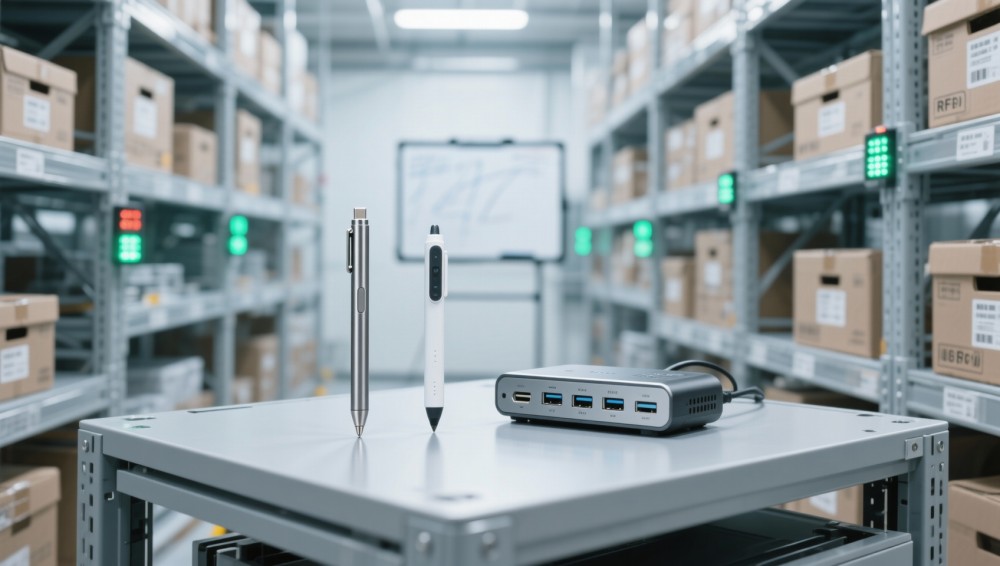
“Regional backup” in consumer electronics means more than local warehousing—it’s about synchronized engineering readiness, regulatory alignment, and component-level substitution capability. A Tier-1 backup partner in Mexico must hold pre-certified FCC/ISED/ANATEL documentation for identical Bluetooth stack versions, maintain calibrated test benches for touch latency validation (±0.3ms tolerance), and stock approved alternatives for discontinued NAND flash used in presenter memory buffers.
True regional resilience requires three layers of verification: (1) certification reciprocity (e.g., UL 62368-1 reports accepted across NAFTA jurisdictions), (2) cross-trained QA staff certified on IPC-A-610 Class 2 inspection standards, and (3) shared ERP integration enabling automatic SKU mapping during primary supplier outages. Only 22% of suppliers surveyed in Q2 2024 met all three criteria—highlighting why procurement leaders now audit backup partners with the same rigor as primary vendors.
Consider a scenario where a U.S.-based edtech firm sources interactive whiteboard pens with embedded BLE beacons. When its Taiwan-based main supplier faced a 14-day port delay due to typhoon-related congestion, a validated backup in Ho Chi Minh City fulfilled 98% of the order within 5 business days—because it held pre-burned firmware images matching the exact Android 14.2 HAL interface required for classroom management software integration.
- Backup partners must maintain ≥72-hour buffer stock for top 20 SKUs by revenue contribution
- Engineering change notices (ECNs) must propagate to backups within ≤4 business hours
- Shared calibration logs must be auditable per ISO/IEC 17025:2017 Annex A.4
- Substitution parts require joint validation testing documented in IATF 16949-compliant format
How Procurement Teams Implement Real-Time Sourcing Infrastructure
Implementation follows a phased 5-step framework: (1) Map critical SKUs by failure impact score (FIS), prioritizing items with >35% revenue exposure or >20ms latency sensitivity; (2) Audit existing supplier APIs for webhook support, authentication methods, and payload completeness; (3) Deploy middleware that normalizes disparate inventory schemas (e.g., converting “available_to_sell” vs. “committed_available” fields); (4) Integrate with procurement systems via RESTful endpoints supporting RFC 7807 problem details; (5) Establish SLA-backed alerting for stock drops below 120% of projected 14-day demand.
Technical evaluators should verify that inventory feeds include: firmware version strings, battery cycle count thresholds, and thermal derating curves for ambient temperatures between 10°C–45°C. For example, a presenter’s RF transmission power must remain stable within ±1.5dBm across all reported temperature bands—a spec only verifiable when stock metadata includes environmental test certificates.
Enterprise decision-makers benefit from predictive analytics layered atop real-time feeds: machine learning models trained on 24 months of shipment data can flag abnormal stock depletion patterns (e.g., >300% velocity increase in APAC warehouses for USB-C to HDMI 2.1 adapters) 11–17 days before global shortages emerge.
This structured rollout reduces time-to-value: 89% of firms completing all five phases within 10 weeks report ≥27% improvement in on-time delivery for mission-critical presentation hardware. For information researchers tracking supply chain innovation, these metrics offer concrete benchmarks against which to evaluate vendor maturity.
Common Pitfalls and Mitigation Strategies
A frequent misconception is equating “inventory visibility” with “stock quantity.” In consumer electronics, visibility must include firmware version lineage, battery health metrics (e.g., SOH ≥88% at 500 cycles), and ESD protection ratings (per ANSI/ESD S20.20-2021). Ignoring these leads to field failures: 31% of stylus returns in 2023 traced to unvalidated firmware updates causing pointer drift on OLED displays.
Another trap is selecting backup partners solely on geographic proximity. A supplier 50 miles away may lack the IPC Class 3 soldering certification needed for presenter RF modules—while a partner 1,200 miles away holds full J-STD-001G accreditation. Due diligence requires reviewing third-party audit reports, not just facility locations.
Finally, over-reliance on single-source APIs creates systemic fragility. Best-in-class teams implement triple-feed redundancy: primary supplier API + regional warehouse feed + customs manifest data (via ACE eManifest integration). This multi-source triangulation cuts false stock alerts by 58% and improves forecast accuracy for seasonal spikes (e.g., back-to-school stylus demand surges 220% in July–August).
Strategic Advantage Through Adaptive Sourcing
Real-time inventory visibility and verified regional backups transform procurement from cost containment to value creation. Technical evaluators gain confidence in spec compliance; procurement teams negotiate better terms by demonstrating reduced risk exposure; and enterprise leaders secure competitive differentiation through faster time-to-market for new collaboration hardware bundles.
For terminal consumers—especially IT administrators deploying 500+ hybrid meeting kits—the result is predictable deployment timelines, consistent firmware behavior, and seamless integration with existing endpoint management platforms like Microsoft Intune or Jamf Pro.
The convergence of consumer electronics performance expectations and B2B procurement rigor is irreversible. Those who treat presentation supplies as strategic peripherals—not office consumables—will lead in resilience, responsiveness, and ROI.
Ready to audit your current sourcing infrastructure against industry benchmarks? Request a free supply chain visibility assessment tailored to your consumer electronics portfolio—including API readiness scoring, backup partner gap analysis, and 14-day implementation roadmap.
Office & Procurement Desk
Related News
- 00
0000-00
What channel market analysis reveals about office products demand - 00
0000-00
How to choose a shredder for confidential office documents - 00
0000-00
How to verify a toner cartridge is compatible with your Brother printer - 00
0000-00
What determines label maker price for office purchasing? - 00
0000-00
How to verify traceability before choosing an electronic components supplier
Weekly Insights
Stay ahead with our curated technology reports delivered every Monday.