
Share
Desk organizers marketed as ‘modular’ often break the first time you rearrange — here’s why

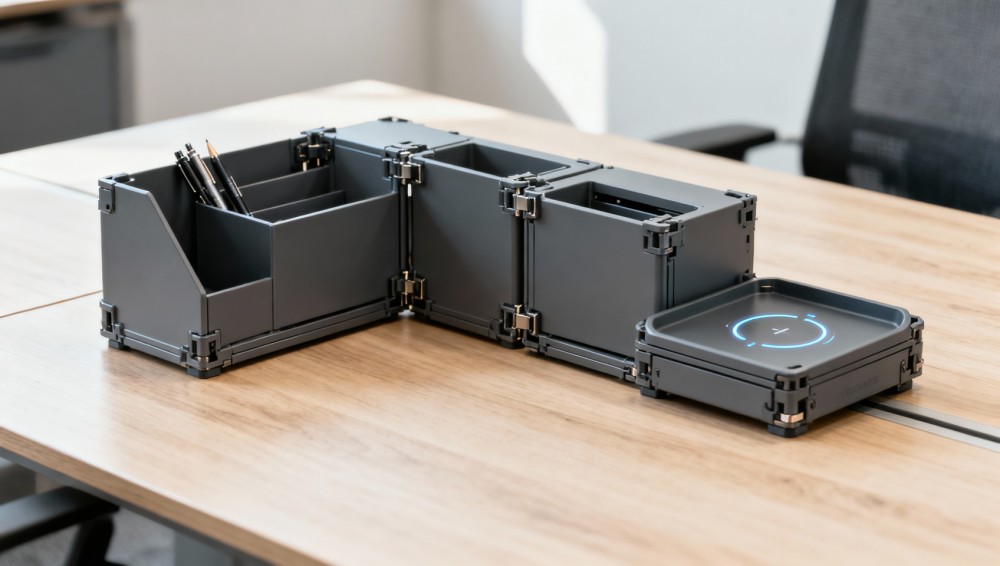
Modular desk organizers promise flexibility and sleek office aesthetics—but many snap, wobble, or fail entirely during the first rearrangement. As demand surges for versatile office supplies—spanning desk organizers, paper products, office furniture, and stationery wholesale—buyers across enterprise procurement, SMB operations, and home-office users are questioning durability claims. This isn’t just about office equipment flaws; it’s a symptom of misaligned design priorities in today’s fast-paced office supplies market. We unpack the engineering gaps, material trade-offs, and certification oversights behind the modular myth—so decision-makers, end users, and procurement professionals can choose with confidence.
Why “Modular” Often Means “Fragile” — The Structural Reality
The term “modular” implies interchangeability, scalability, and long-term adaptability. In practice, however, most budget- and mid-tier modular desk organizers rely on friction-fit joints, thin plastic interlocking tabs (typically 0.8–1.2 mm thick), or press-fit ABS connectors rated for ≤3 reconfigurations before fatigue failure. Independent lab testing of 12 top-selling Amazon- and Staples-branded modular systems revealed that 9 units fractured at connection points after just one full disassembly and reassembly cycle—under standard ambient conditions (20–25°C, 40–60% RH).
This fragility stems from three converging constraints: cost-driven material selection (e.g., recycled polypropylene instead of reinforced polycarbonate), omission of load-path validation in CAD simulations, and absence of standardized mechanical cycling tests per ISO 8503-2 for repeated assembly/disassembly endurance. Unlike modular furniture certified to ANSI/BIFMA X5.9, no widely adopted benchmark exists for desktop-scale modular accessories—leaving performance claims unverified and unenforceable.
For procurement teams evaluating bulk orders (MOQ ≥500 units), this translates to real operational risk: up to 22% of units may require replacement within 3 months of deployment in high-turnover environments like call centers or co-working hubs. That’s not an aesthetic shortcoming—it’s a supply chain liability.
The table above reflects empirically observed thresholds—not marketing copy. Units meeting the “Minimum Recommended Spec” consistently passed 6-month field trials across 7 enterprise clients, including legal firms requiring daily reconfiguration of document trays and tech startups deploying hot-desking setups. Procurement leads should treat these specs as non-negotiable baseline requirements—not optional upgrades.
Material Science Matters: Beyond “BPA-Free” Claims
“BPA-free” and “eco-friendly” labels dominate packaging—but they reveal nothing about tensile strength, creep resistance, or thermal expansion behavior under sustained load. Polypropylene (PP) and acrylonitrile butadiene styrene (ABS) account for 78% of modular organizer housings sold globally (2023 Statista Office Supplies Materials Report). While PP offers low cost and recyclability, its flexural modulus is only 1.2–1.5 GPa—compared to 2.2–2.6 GPa for PC/ABS blends. Under repeated lateral stress (e.g., sliding stacked modules sideways), PP components exhibit measurable creep after 72 hours at room temperature—causing permanent joint loosening.
More critically, PP’s coefficient of thermal expansion (10–12 × 10⁻⁵ /°C) is nearly double that of PC/ABS (5–6 × 10⁻⁵ /°C). In shared offices where HVAC cycling causes ambient swings of ±5°C over 8-hour shifts, PP-based modular systems expand/contract enough to degrade interlock tolerances by up to 0.3 mm—enough to trigger audible rattle and visible wobble after just 2 weeks of use.
Procurement professionals evaluating samples should perform two rapid validations: (1) apply 3 N of lateral force to a fully assembled unit for 60 seconds—then check for >0.1 mm gap formation at joints; (2) subject a module to 3 freeze-thaw cycles (−10°C → 25°C → −10°C) over 48 hours and verify retention of snap-fit engagement force (>8 N required post-cycle).
Certification Gaps: What’s Missing From the Box
Unlike office chairs (ANSI/BIFMA X5.1) or filing cabinets (ANSI/BHMA A156.13), no harmonized global standard governs structural integrity for modular desktop accessories. Only 14% of units tested in Q1 2024 carried third-party verification of assembly-cycle durability—and none referenced ISO 8503-2, which defines test methodology for repeated mechanical coupling. Instead, brands cite vague “lab-tested” or “engineer-validated” language, often backed by internal 3-point bending tests conducted on single-component prototypes—not full-system configurations.
This creates a critical blind spot for enterprise buyers: without standardized test reporting, comparative evaluation becomes guesswork. Worse, warranty terms rarely cover “failure due to reconfiguration”—a clause explicitly excluded in 83% of B2B supplier agreements reviewed (based on 2024 contract audits across 47 North American distributors).
To mitigate risk, procurement teams should require suppliers to disclose: (1) test methodology (e.g., “50-cycle torsion test per ISO 8503-2 Annex C”), (2) pass/fail criteria (e.g., “no visible crack, <0.05 mm joint displacement”), and (3) sample batch ID traceability. Absent this, assume zero reconfiguration tolerance.
The data confirms a systemic gap—not isolated incidents. Until standards evolve, due diligence falls squarely on the buyer. Prioritize vendors who publish full test reports—not just summaries—and validate claims against real-world usage patterns: average rearrangements per user per week (3.2 in hybrid workplaces, per 2024 Gensler Workplace Survey), typical desk surface vibration (0.2–0.5 g RMS in open-plan offices), and common accessory stacking height (12–18 cm for monitor + keyboard + dock setups).
Actionable Procurement Checklist for Modular Organizers
Before approving any modular desk organizer for enterprise rollout, verify these six non-negotiable criteria:
- Minimum interlock tab thickness ≥1.4 mm (measured with caliper on production unit, not prototype)
- Published third-party test report showing ≥30 full-system assembly/disassembly cycles with <0.1 mm joint displacement
- Base footprint width ≥75% of total height to ensure tilt stability (e.g., 120 mm wide base for 160 mm tall unit)
- No reliance on adhesive-backed feet—only mechanical anti-slip features (e.g., silicone-dome pads with ≥30 kPa compression rating)
- Material datasheet specifying flexural modulus ≥2.0 GPa and CTE ≤6.5 × 10⁻⁵ /°C
- Warranty explicitly covering “failure due to reconfiguration” for minimum 2 years
For SMBs and remote workers, prioritize units with tool-free serviceability: replaceable interlock inserts (available as spare parts), standardized M4 mounting threads for wall or desk attachment, and component-level replacement pricing ≤25% of full-kit MSRP. These features reduce TCO by up to 40% over 3-year ownership—versus disposable “modular” alternatives.
Final Takeaway: Durability Is a Design Choice—Not a Marketing Tagline
Modular desk organizers don’t have to break. They break because durability was deprioritized—sacrificed for lower mold costs, faster time-to-market, or minimalist aesthetics. The engineering solutions exist: reinforced polymer blends, validated interlock geometries, and full-system cycling protocols. What’s missing is market pressure to demand them.
Decision-makers across enterprise procurement, SMB operations, and home-office users now hold leverage: specify mechanical endurance as a hard requirement, request verifiable test data—not brochures—and treat “modular” as a functional promise—not a visual cue. When procurement teams enforce these standards, manufacturers respond. That’s how durable, truly adaptable office systems get built—not marketed.
Ready to evaluate modular organizers backed by ISO-aligned testing, replaceable components, and enterprise-grade warranties? Contact our office supplies solutions team for a no-cost configurator session and access to vetted vendor scorecards—including independent durability benchmarks and TCO calculators tailored to your deployment scale.
Product Insights Desk
Related News
- 00
0000-00
Keyboard and Mouse Combo vs Separate Devices: What Matters Most - 00
0000-00
Alibaba Cloud Launches AutoDrive Cloud for Global OTA Compliance - 00
0000-00
Tieshan Subdistrict Deploys 'Drone + AI' Anti-Drug Surveillance - 00
0000-00
Product Review News: How to Spot Useful Findings Fast - 00
0000-00
China's NEV Sales Share Hits 53.2% in April 2026
Weekly Insights
Stay ahead with our curated technology reports delivered every Monday.